

By Jane Rohde
Introduction
This month, Sunbrella is bringing to you; Evidence Based Design: Resources for Senior Living! Sharing resources and building the evidence is an important aspect of working in all segments of healthcare. Information from post-occupancy evaluations, research that is completed by various educational institutions and health systems, NIH, CDC, GSA, and other governmental agency research studies, and observational site visits are all resources for the design community in evaluating evidence that supports design decisions based upon the specific application, care populations, and overall goals of a project.
Unique Approach to Collaborative Design Guidelines
At the last Environments for Aging Conference, Robert Wrublowsky, Principal Architect at MMP Architects gave a presentation on the newly developed Design Guide for Long Term Care Homes (Guide). His goal is to share this as an open source resource and have others add to the research base by providing information that can be included in updates of the Guide to allow it to be a living document. This is a fresh way of looking at information as a shared growth opportunity to reach a greater saturation of person-centered settings within not just North America, but throughout the World.
Embracing a Cultural Shift for Person-Centered Care
The Guide includes Guiding Principles and provides a comparison of institutional models to small house models, including case studies. The organization of the document includes an evidence based design research topic, the use of icons to provide the associated outcomes for the research topic, an explanation of the design issue that the research topic addresses, EBD interventions and the rationale applicable to the intervention based upon a robust systematic literature search, including rating of the rigor of the research. Robert has generously allowed the Guide to be available on both the Facilities Guidelines Institute website (www.fgiguidelines.org) and on With Seniors In Mind educational website (www.withseniorsinmind.org) as an open source downloadable resource for those working in the senior living and long term care marketplace.
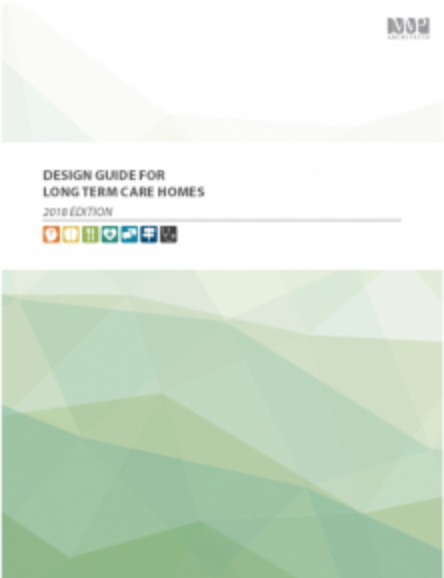
Design Guide for Long Term Homes. Available with permission: ©2017 Robert Wrublowsky all rights reserved at www.withseniorsinmind.org.
The Guide was part of a recent presentation to senior living care providers at the LifeSpan Conference in Maryland. I discussed processes as illustrated within the Guide, the FGI Guidelines for Design and Construction of Residential Health, Care, and Support Facilities, and the Senior Living Sustainability Guide®(www.withseniorsinmind.org). All of the referenced resources have in common wanting to support the deinstitutionalizing of long term care, which requires embracing culture change, creating small house / household environments, operational restructuring, and following Evidence Based Design principles. As part of the programming and planning process using these various resources, our firm always holds focus groups, gleans information at the onset of a project, understands and helps develop the care models that are being considered, and discusses the goals from a person-centered perspective. Ultimately, we are continually asking for involvement by the operational team throughout the programming and design process. The interesting part of the session was the reaction by the operational and care staff in the audience. Apparently, what is the norm for asking the operational staff what works, what doesn’t work, and what is important to their residents is not actually the norm – the care managers, front line, and operational staff are being ignored and not used as the most amazing resource available to a design team! One story included a care manager that told the architect that the bed and furniture configuration that they wanted to utilize was not going to work within the layout of the resident rooms. Their comments were dismissed and ‘waved off’ by the design team. I asked, “…so, what did you do?” She replied, “we {nursing staff} just sat back and watched,” and sure enough they were definitely right, and the beds would not fit into the rooms! This was one of many stories that I have heard in the last few years about design teams “knowing better” instead of embracing the resources that are readily available to assist with making evidence based, thoughtful, and meaningful decisions that improve resident outcomes and quality of life for both staff and residents. When assisting a client with a repositioned project or building a new or replacement project, it is essential to gather information from the operational team, residents, and their families. If we design something that is decentralized, but the operational team does not provide feedback and education/training for front line staff, they will carry over the centralized, institutional model of care over to the new decentralized setting. This is setting up a new project environment to fail – the discussions upfront in the planning programming process are the most important prior to completing any design concepts or solutions. Building a framework that assists with decision-making and maintaining the framework throughout the project design process through construction allows all team members to understand the project goals that should support the resident outcomes and ease of staff to implement the desired care model.
Conclusion
Robert and I share the recommendation that all healthcare designers should read Atul Gawande’s Being Mortal – as quoted in the beginning of the Guide: “Making lives meaningful in old age is new. It therefore requires more imagination and invention than making them merely safe does”. This is our charge as designers for older adults and other potentially vulnerable populations – collaborate, share, and understand those that you are designing for – including the staff, families, and specifically the residents.
Blog written for Sunbrella.